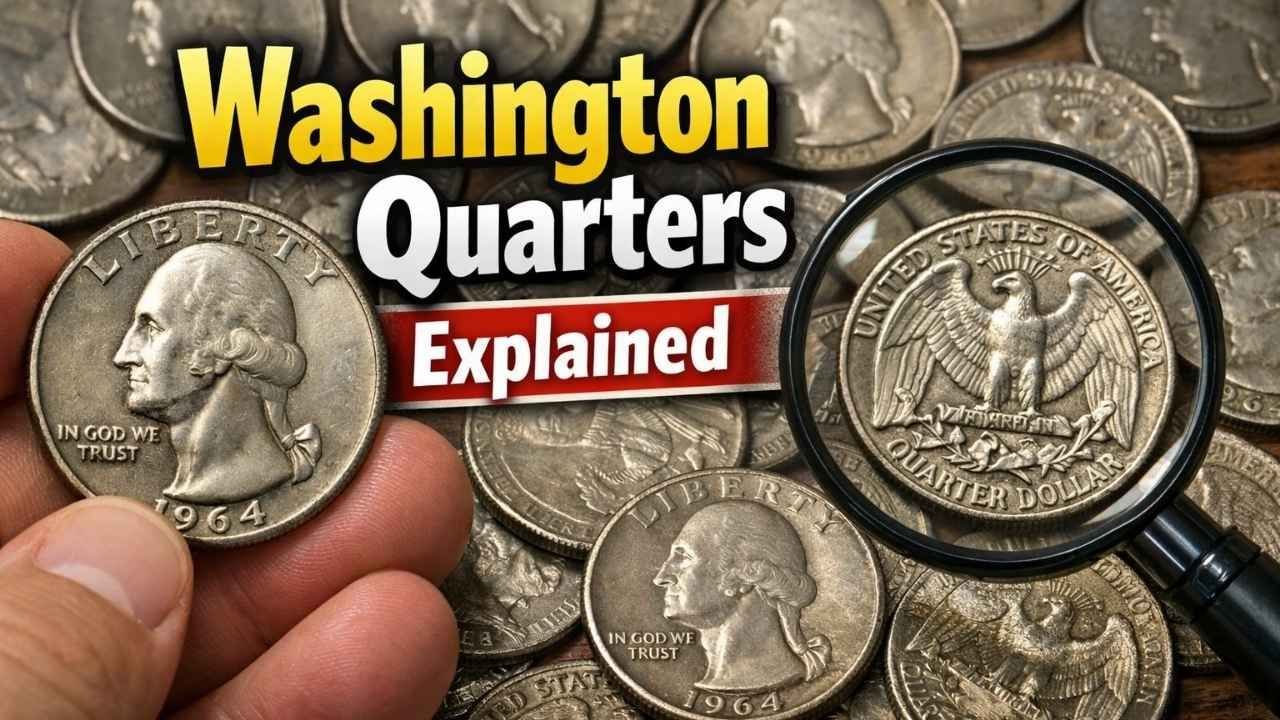
The Washington Quarter is one of the most recognizable coins ever produced by the United States. Introduced in 1932 to honor the 200th anniversary of George Washington’s birth, it was initially intended as a commemorative issue. Instead, it became a permanent fixture of American commerce — and remains in circulation today.
Over nearly a century, the coin has evolved through changing metals, artistic redesigns, and major commemorative programs. For collectors and investors, the Washington Quarter offers historical depth, silver value, and surprising rarity in key dates.
Here is a complete guide to its design history, mintage figures, and market value.
The Origins of the Washington Quarter
In 1932, the U.S. Mint sought to commemorate the bicentennial of George Washington. A national design competition was held, and sculptor John Flanagan won with his classical portrait of Washington.
The new quarter replaced the Standing Liberty design and was originally expected to be temporary. However, the public response was overwhelmingly positive. The coin was adopted permanently, marking the first time a U.S. circulating coin depicted a real historical president instead of a symbolic figure.
Design Evolution Through the Decades
1932–1964: The Silver Era
The original Washington Quarter was struck in 90% silver and 10% copper.
Obverse: A left-facing portrait of George Washington with the motto “IN GOD WE TRUST.”
Reverse: A heraldic eagle perched on a bundle of arrows, framed by olive branches.
These silver quarters are highly sought after today, not only for their numismatic appeal but also for their intrinsic bullion value.
1965–1998: The Clad Transition
Rising silver prices in the mid-1960s prompted the U.S. Mint to eliminate silver from circulating quarters. Beginning in 1965, the composition shifted to a copper core bonded with outer layers of copper-nickel.
While the design remained largely unchanged, these clad quarters are generally worth face value unless found in uncirculated condition or as error varieties.
1999–2008: The 50 State Quarters Program
In 1999, the Mint launched the enormously successful 50 State Quarters Program. Each state received a unique reverse design released in the order of statehood.
This initiative transformed coin collecting into a nationwide phenomenon. Millions of Americans began searching pocket change, and collector interest surged globally.
2009–2021: America the Beautiful
The America the Beautiful Quarters followed, featuring national parks and historic landmarks. Five new designs were released each year, showcasing iconic American landscapes.
2022–Present: American Women Quarters
The most recent redesign initiative is the American Women Quarters Program, honoring influential women who shaped American history. This modern era reflects a broader cultural narrative while retaining Washington’s portrait on the obverse.
Early Mintage Figures and Key Dates (1932–1941)
Early production numbers play a critical role in determining value. Below are selected highlights from the first decade:
- 1932-D: 436,800 minted — one of the lowest in the entire series.
- 1932-S: 408,000 minted — similarly scarce.
- 1934: Over 31 million minted, but doubled die varieties exist.
- 1937: Known for doubled die errors.
- 1938-S: Lower mintage year with collector interest.
- 1941: Production surged due to wartime economic demand.
The 1932-D and 1932-S issues are widely considered the “key dates” of the series.
What Determines Washington Quarter Value?
The market value of a Washington Quarter depends on several interconnected factors:
1. Year and Mint Mark
Coins minted in Denver (D) and San Francisco (S) often had lower production numbers in early years. The 1932-D and 1932-S are prime examples of how mintage scarcity drives premiums.
2. Condition (Grade)
Grading plays a decisive role in value. Coins in:
- Good (G) condition show heavy wear.
- Extremely Fine (XF) retain strong detail.
- Mint State (MS) show no circulation wear.
A key date quarter in Mint State can be worth ten times more than a circulated example.
3. Silver Content
All quarters minted before 1965 contain 90% silver. Even heavily worn examples retain melt value tied to gold and silver market fluctuations.
4. Errors and Varieties
Doubled dies, repunched mint marks, and other striking anomalies can significantly increase desirability. The 1934 Doubled Die and 1937 Doubled Die are especially collectible.
Current Value Ranges
While prices fluctuate based on grading and market conditions, approximate ranges include:
- 1932-D: $100+ in circulated condition; $1,000+ in uncirculated grades.
- 1932-S: $80+ circulated; $800+ in higher grades.
- 1934 Doubled Die: $50+ circulated; $500+ uncirculated.
- 1964 (last silver year): Generally valued near silver melt; $20+ in uncirculated condition.
- Common clad issues (post-1965): Face value unless pristine or error varieties.
High-grade certified examples often command significant premiums at auction.
Historical and Cultural Significance
The Washington Quarter represents more than monetary utility. It reflects:
- America’s respect for its founding leadership.
- The economic shift from precious metals to modern alloy coinage.
- The democratization of collecting through national programs.
- A nearly century-long design continuity unmatched by most circulating coins.
Few coins have adapted so seamlessly to changing economic conditions while maintaining iconic status.
Investment Perspective
For investors, Washington Quarters offer layered value:
- Bullion security in pre-1965 silver issues.
- Collector premiums for rare dates and high grades.
- Long-term historical appreciation for key varieties.
While common clad quarters are not investment-grade assets, early silver issues and scarce mintages continue to perform strongly in the collector market.
Collector Strategies
Serious collectors often focus on:
- Completing a 1932–1964 silver set.
- Acquiring key dates in certified Mint State.
- Searching for doubled dies and other varieties.
- Building full runs of commemorative programs such as the State Quarters.
Proper storage in archival-quality holders is essential to preserve condition and long-term value.
Why the Washington Quarter Endures
Nearly 100 years after its debut, the Washington Quarter remains both practical currency and a canvas for national storytelling. Its design has honored presidents, states, natural landmarks, and influential women — all while maintaining continuity with its 1932 origins.
Whether viewed through a historical lens or an investment portfolio, the Washington Quarter stands as one of the most versatile and enduring coins in American numismatics.
For collectors, it offers accessibility at entry levels and significant upside at the highest grades. For historians, it chronicles nearly a century of American identity — struck, quite literally, in metal.