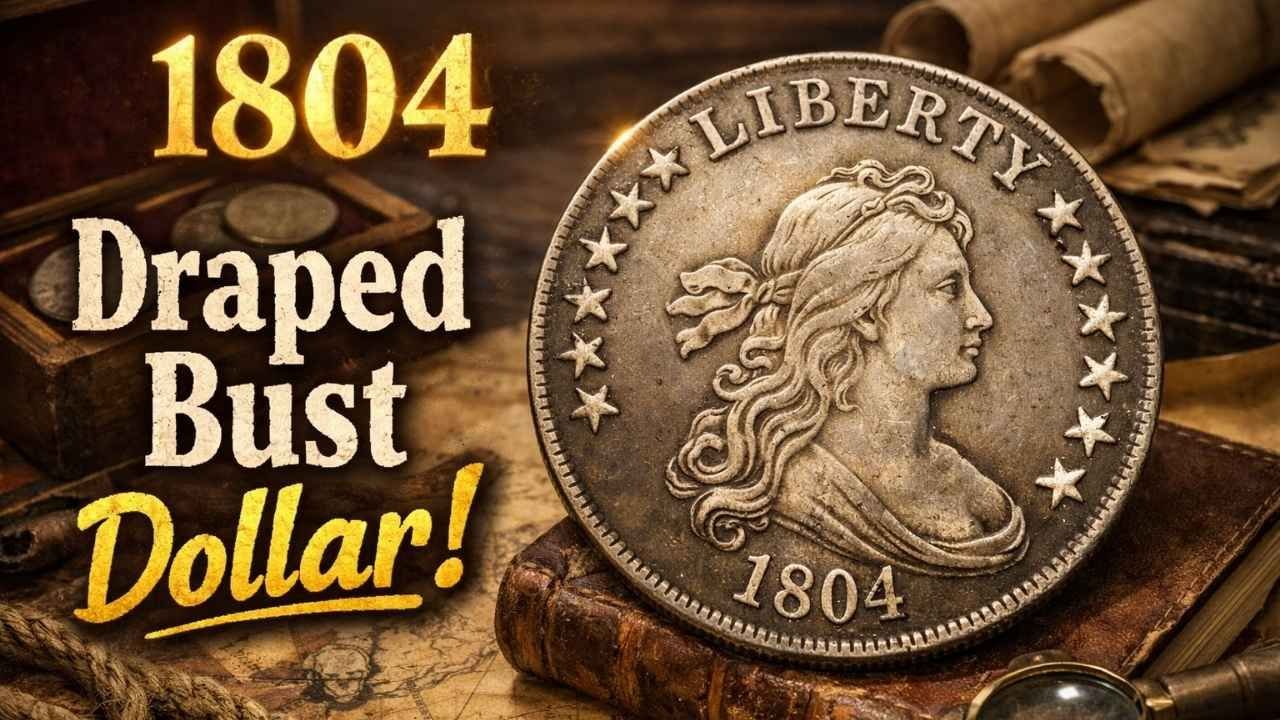
Few objects in American numismatic history command the reverence, mystery, and prestige of the 1804 Draped Bust Dollar. Often called the “King of American Coins,” this legendary silver dollar represents the pinnacle of rarity and desirability.
Despite the 1804 date on its face, the coin was not struck in that year. Instead, it was produced decades later under unique diplomatic circumstances—an origin story that elevates it from a mere collectible to a cultural icon. With only sixteen confirmed examples in existence, the 1804 Dollar occupies an elite tier reserved for the most significant treasures in American coinage.
For serious collectors and investors alike, it represents far more than precious metal. It symbolizes history, exclusivity, and enduring financial power.
Historical Origins: A Coin That Wasn’t What It Seemed
The Draped Bust Dollar design was introduced in 1795 and remained in production until 1804. The obverse featured Liberty with flowing hair and a draped neckline, while the reverse displayed a heraldic eagle inspired by the Great Seal of the United States.
By 1804, however, the United States Mint had already halted silver dollar production for circulation. Officially, no silver dollars dated 1804 were struck that year.
The story takes a dramatic turn in 1834. Under the direction of Andrew Jackson, special proof coin sets were commissioned as diplomatic gifts for foreign dignitaries. These presentation sets were intended to showcase every denomination then in official use.
When Mint officials discovered there were no silver dollars available from recent years, they created new dies dated 1804—believing it to be the last year dollars had been authorized for coinage. Thus, the first 1804 Draped Bust Dollars were born, not as circulating currency but as carefully crafted diplomatic proofs.
The Three Classes of 1804 Dollars
Numismatists categorize the 1804 Dollar into three distinct classes, each with its own historical context and rarity profile.
Class I (Original Diplomatic Issues)
Struck in 1834–1835, these coins were included in official proof sets presented to foreign leaders. Eight examples are known today.
They are considered the most historically significant, as they represent the original diplomatic purpose behind the coin’s creation.
Class II (Mint Experiment)
Only one Class II example exists.
Believed to have been struck in the 1850s as a Mint experiment, this coin was created over a previously struck silver dollar. It differs in edge lettering and is widely regarded as a transitional piece in the coin’s unusual history.
Class III (Collector Issues)
Seven Class III coins were produced in the 1850s and 1860s, largely to satisfy growing collector demand.
Although technically restrikes, they remain authentic Mint products and are highly prized. These examples demonstrate how rapidly American coin collecting was evolving into a serious and competitive pursuit.
Design Excellence and Artistic Merit
The 1804 Draped Bust Dollar is admired not only for its rarity but also for its elegance.
The obverse portrays Liberty in a refined neoclassical style, framed by thirteen stars representing the original states. The reverse features a heraldic eagle with shield, arrows, and olive branch—symbols of strength and peace.
Struck as proofs, the coins exhibit deeply mirrored fields and sharp, frosted design elements. The contrast between devices and background produces a dramatic visual impact rarely seen in early American coinage.
In hand, the coin exudes craftsmanship and precision—qualities that elevate it beyond simple monetary value.
From Obscurity to Icon
The 1804 Dollar was not widely recognized as extraordinary until the mid-19th century.
Its growing fame was fueled in part by early numismatic publications, including A Manual of Gold and Silver Coins of All Nations by Jacob R. Eckfeldt and William E. Du Bois. Their documentation brought attention to the coin’s rarity and historical intrigue.
By the late 1800s, the 1804 Dollar had become a centerpiece in elite collections. Its mystique only grew as auction appearances remained rare and competition intensified among wealthy collectors.
Over time, it earned its royal nickname—and rightfully so.
Legendary Provenance and Record Auctions
Individual specimens of the 1804 Draped Bust Dollar have passed through some of the most distinguished collections in American history.
Notable owners have included Virgil Brand, one of the most prolific collectors of his era, and Louis Eliasberg, the only collector to assemble a complete collection of U.S. coins by date and mintmark.
The so-called Sultan of Muscat specimen—part of the original diplomatic presentation—remains one of the finest known examples.
Auction records for the coin consistently reach into the millions. In recent decades, top-quality specimens have sold for well over $3 million, reinforcing the coin’s position as both a historical treasure and a blue-chip asset in the rare coin market.
Why the 1804 Dollar Commands Such Value
Several factors combine to make this coin one of the most coveted in the world:
Extreme Scarcity
With only sixteen known examples across all classes, supply is permanently fixed.
Historical Significance
Its creation ties directly to diplomatic missions and early U.S. Mint operations.
Proof-Only Status
These coins were never intended for circulation, making every surviving piece a presentation-quality artifact.
Legendary Reputation
Few coins enjoy a universally recognized title. “King of American Coins” carries weight across the global collecting community.
Investment Prestige
At the highest levels of wealth preservation, rare coins like the 1804 Dollar function as tangible assets with proven demand and global recognition.
A Symbol of Numismatic Excellence
Beyond price and rarity, the 1804 Draped Bust Dollar represents the maturation of American coinage and the rise of organized collecting.
It reflects a period when diplomacy, artistry, and Mint craftsmanship intersected in extraordinary ways. Its survival through nearly two centuries—despite its limited production—underscores its resilience as a historical artifact.
For institutions, it is a museum centerpiece. For private collectors, it is the ultimate prize. For investors, it is a store of legacy value.
Enduring Modern Legacy
Today, the 1804 Dollar continues to captivate new generations. High-quality replicas and commemorative issues allow enthusiasts to appreciate its design, while original specimens remain securely housed in premier collections and exhibitions.
Its story is regularly referenced in discussions about elite collectibles and alternative assets. In a world increasingly driven by digital finance, the 1804 Draped Bust Dollar stands as a reminder that tangible history still holds immense power.
Conclusion
The 1804 Draped Bust Dollar is more than a rare coin—it is an enduring symbol of American heritage, craftsmanship, and prestige. Born from diplomatic necessity and shaped by collector passion, it has transcended its silver composition to become a global icon.
Its rarity is absolute. Its history is remarkable. Its reputation is unmatched.
For nearly two centuries, it has ruled the world of American numismatics—and its reign shows no sign of ending.