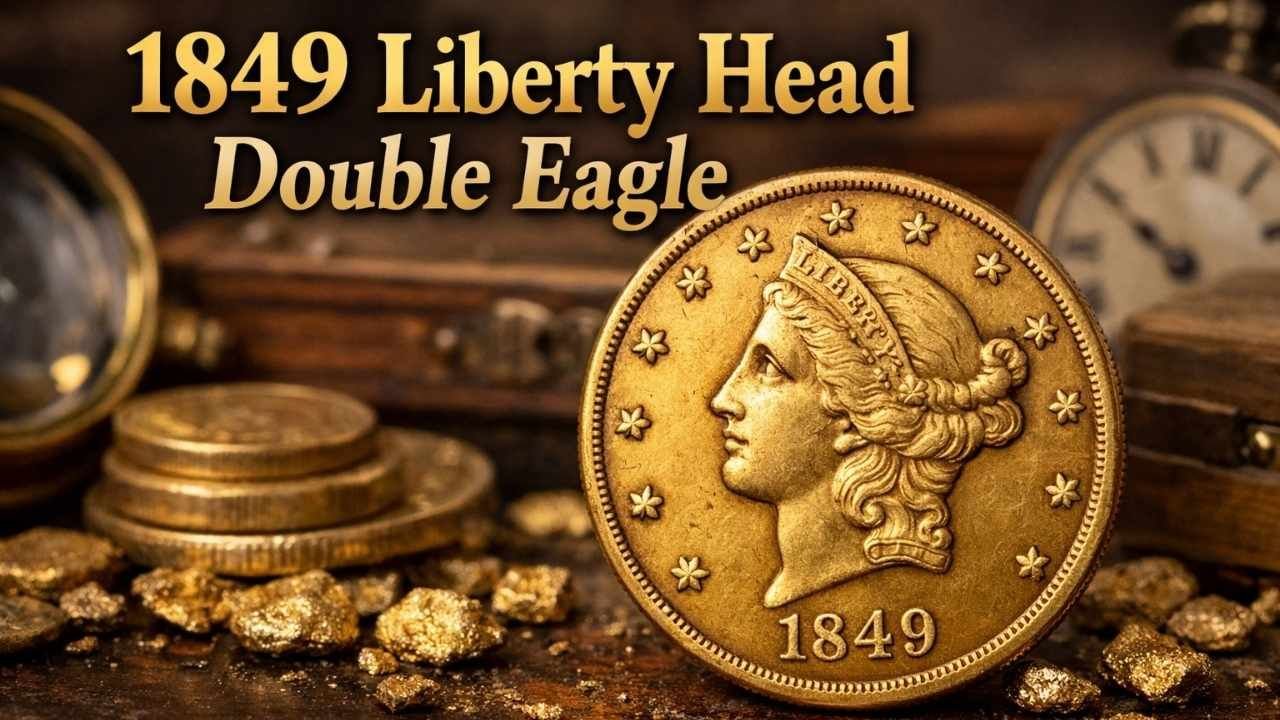
The 1849 Liberty Head Double Eagle stands at the pinnacle of American numismatics. More than a coin, it represents a turning point in U.S. economic history — the moment when the nation responded to unprecedented wealth flowing from the California Gold Rush. Unlike most first-year issues, this coin is not simply rare. It is unique. Only one example was ever struck for official purposes, and today it rests permanently inside the National Numismatic Collection at the Smithsonian Institution.
For collectors and investors, the 1849 Double Eagle is not just valuable — it is untouchable, a national treasure that symbolizes ambition, expansion, and financial transformation.
The California Gold Rush and the Birth of the $20 Gold Coin
In 1848, gold was discovered at Sutter’s Mill in California, igniting one of the most significant economic migrations in American history — the California Gold Rush. By 1849, tens of thousands of prospectors were mining vast quantities of gold, dramatically increasing the nation’s bullion supply.
At the time, the largest circulating U.S. gold coin was the $10 Eagle. But with so much gold entering the economy, larger denominations became necessary for efficient trade, banking, and international commerce.
Congress authorized a new $20 gold coin — the Double Eagle — to handle large-scale transactions. The result was a bold new denomination that would go on to play a central role in American finance for nearly six decades.
The first step in that journey was the 1849 pattern coin.
The Vision of James B. Longacre
The coin was designed by James B. Longacre, Chief Engraver of the United States Mint. His Liberty Head design would become one of the most enduring images in American coinage.
Obverse Design
Lady Liberty faces left, wearing a coronet inscribed with “LIBERTY.” Thirteen stars surround her portrait, representing the original states, with the date below.
Reverse Design
A heraldic eagle spreads its wings behind a shield, holding arrows and an olive branch — symbols of military strength and peace. The denomination appears as “TWENTY D.”
This design remained in production from 1850 through 1907, making it one of the longest-running gold coin designs in U.S. history.
Technical Specifications
The 1849 Double Eagle was a substantial coin — physically impressive and financially significant.
- Denomination: $20
- Composition: 90% gold, 10% copper
- Gold Content: 0.96750 troy ounces
- Weight: 33.44 grams
- Diameter: 34 mm
- Edge: Reeded
- Mintage: 1 (pattern strike)
Its size and gold weight made it one of the most imposing coins ever produced by the United States Mint.
Why Only One Exists
The 1849 Liberty Head Double Eagle was struck as a pattern — essentially a prototype created to test the new denomination. While additional pieces were anticipated, only one official specimen was completed and preserved.
Rather than entering circulation, the coin remained in Mint custody and eventually became part of the national collection. Today, it resides within the National Numismatic Collection at the Smithsonian Institution in Washington, D.C.
Because it is government property and held in trust for the public, the coin has no market price. It cannot be privately owned, auctioned, or traded. Its value is historical rather than commercial — and arguably beyond calculation.
A Symbol of Economic Transformation
The 1849 Double Eagle represents more than rarity. It marks the moment when America evolved into a gold-driven economic power.
The introduction of the $20 denomination enabled:
- Large-scale commercial transactions
- Expansion of banking systems in the West
- International trade backed by gold reserves
- Efficient transport of high-value bullion
In practical terms, it modernized American finance during a period of explosive growth.
For historians, it embodies the optimism and ambition of a rapidly expanding nation.
The Liberty Head Double Eagle Series (1850–1907)
While the 1849 coin was unique, regular production began in 1850. Over the next 57 years, millions of Liberty Head Double Eagles were minted across several facilities.
The series is divided into three major types:
Type I (1850–1866)
Original design without the motto “In God We Trust.”
Type II (1866–1876)
The motto “In God We Trust” was added above the eagle following the Civil War.
Type III (1877–1907)
Reverse modified to spell out “TWENTY DOLLARS” instead of the abbreviated “TWENTY D.”
These coins circulated heavily, particularly in western states where gold commerce was common.
High-Value Liberty Head Double Eagles
Although none rival the uniqueness of the 1849 specimen, several issues within the series command extraordinary prices:
- 1850 (Philadelphia) — First regular issue; high-grade examples can exceed $20,000.
- 1861 Paquet Reverse — A rare design variation valued at $100,000+ in top condition.
- 1870-S — Extremely rare San Francisco issue; examples have surpassed $1 million at auction.
- 1904 (Philadelphia) — A more common issue, typically valued between $2,000 and $5,000 depending on grade.
These values reflect a combination of gold content, rarity, mint history, and collector demand.
Investment Appeal in Modern Markets
Liberty Head Double Eagles occupy a unique position in the luxury asset space. They offer two layers of value:
- Intrinsic Gold Value — Each coin contains nearly a full ounce of gold, providing a built-in hedge against inflation.
- Numismatic Premium — Scarcity, historical relevance, and condition can dramatically increase value beyond bullion prices.
As tangible assets with deep historical roots, these coins appeal to collectors, investors, and wealth preservation strategists alike.
Auction houses consistently report strong demand for high-grade examples, particularly rare mint marks such as Carson City (CC) and San Francisco (S).
The Smithsonian Specimen: A National Treasure
The sole 1849 Double Eagle remains one of the most celebrated coins in American history. Preserved within the Smithsonian Institution, it stands alongside the most important artifacts of U.S. monetary heritage.
Its presence in a public collection ensures that it remains accessible — not to collectors’ vaults, but to the nation itself.
Few objects so perfectly capture the intersection of history, art, and economic evolution.
Why the 1849 Double Eagle Still Matters
The 1849 Liberty Head Double Eagle is not simply America’s rarest gold coin. It represents innovation born from opportunity. It marks the financial awakening of a nation responding to sudden prosperity.
For modern collectors, the broader Liberty Head series offers attainable pieces of that story. For historians, the 1849 specimen remains a symbol of ambition and transformation.
In a world increasingly driven by digital finance and intangible assets, this singular gold coin reminds us that wealth once had weight — and history was struck in metal.